Tag Archive for: public sector evaluation

Choosing an evaluation consultant? Learn what charities, not-for-profits and public sector teams could look for when appointing an external evaluator.

How to Choose the Right Evaluation Consultant for Your Project

If you are a charity, not-for-profit or public sector organisation looking for an evaluation consultant in the UK, it can be hard to know who to appoint.

From the outside, evaluators can look quite similar. Most will talk about impact, evidence, methods and reporting. Most can write a proposal that sounds credible. But the real question is not simply who writes the most polished tender.

The real question is: who will help you understand your project clearly, collect the right evidence, and turn that evidence into something you can actually use?

That matters because evaluation is often commissioned at an important moment. You might be preparing for a major grant, working through a development stage, or starting delivery after a significant funding award. There is usually a lot at stake. You need confidence that the evaluation will satisfy funders, support learning and help your team make better decisions.

So how do you choose the right evaluation consultant?

Start by asking people you trust

One of the best ways to find a good evaluator is still the simplest: ask around.

Ask your peers. Ask partner organisations. Ask funders, advisers, trustees or other senior leaders who have commissioned evaluation before. If someone has had a good experience with an evaluator, they will usually be able to tell you what made the process work.

This is useful because evaluation is not just a technical service. It is a working relationship.

You need someone who can understand the project, work well with senior leaders and delivery teams, ask good questions, make sense of complexity and communicate findings clearly. A recommendation from someone who has already worked with an evaluator can tell you a lot more than a website or proposal alone.

Look for relevant experience and previous work

Track record matters.

If your project involves community engagement, arts and culture, heritage, nature, health, wellbeing or place-based work, it helps to appoint someone who understands those settings. They do not need to have evaluated an identical project, but they should understand the reality of delivery.

Good evaluators know that participation can be uneven, delivery teams are busy, and community work does not always fit neatly into a spreadsheet. They know how to gather evidence without creating unnecessary work.

Ask to see examples of previous reports or outputs. A useful evaluation report should not just look impressive. It should be readable, honest and practical. You should be able to imagine giving it to trustees, funders, partners or senior colleagues and seeing how it would support decisions.

Ask how they would approach the project

Before asking for a full quote, it is worth having an informal conversation.

Look for evaluators who are willing to offer a 20 to 30 minute chat before they write a proposal. This gives you a much better feel for how they think. What questions do they ask? Do they understand the project quickly? Do they spot the right challenges? Do they make the process feel clearer or more complicated?

It also helps you work out whether you would enjoy working with them.

At The Evaluator, we usually try to have this kind of conversation before writing a quote. It helps us understand the client as well as the project. A tender brief can tell us what the work is, but a conversation often tells us how the organisation thinks, what they are worried about, and where evaluation could be most useful.

That matters because a good evaluator should not just price a list of pre-decided outputs. They should help you work out what level of evaluation is proportionate.

Sometimes organisations ask for more than they need. Three reports might sound thorough, but they may not be the best use of the budget. In some projects, one strong evaluation framework, a small number of well-designed tools and good support with data collection will be far more useful.

Do not judge only by the polish of the tender

A clear proposal matters. But the best evaluation partner is not always the organisation with the glossiest tender.

A larger consultancy may have a dedicated tender writer or more capacity to produce a very polished document. A smaller specialist team may not be able to spend a full week making a proposal look beautiful, because the senior people writing the quote are also the people designing, managing and delivering the work.

That difference matters.

A polished tender does not always tell you who will actually do the evaluation, how involved senior people will be, or whether the evaluator will stay close to the reality of the project once delivery begins.

So look beyond the procurement document. Ask who will lead the work, who will analyse the evidence and who will write the report.

Good evaluation depends on judgement, not just process.

Choose someone who makes evaluation useful

Good evaluation is not about collecting as much data as possible. It is about collecting the right amount of data, in the right way, and using it well.

That is where the best evaluation consultants add value. They help you avoid wasted effort. They design tools that work in real settings. They reduce duplicated requests. They make the process manageable for staff, volunteers, partners and participants.

At The Evaluator, we describe this as being creatively simple.

The process should feel simple for the people taking part. A survey should be easy to complete. A feedback activity should feel welcoming. A workshop should generate useful insight without feeling over-engineered.

Behind the scenes, the analysis may be complex. But that complexity should not be passed on to the client. The evaluator’s job is to do the hard thinking, make sense of the evidence, and present it back clearly.

A good evaluation consultant should bring relevant sector experience, proportionate methods, clear communication, honest analysis and practical recommendations that help funders, boards and delivery teams understand what the evidence means.

Look for honesty, not just positive findings

Evaluation is not marketing.

A good evaluator should recognise success, but they should also tell you what the evidence does and does not show. That kind of honesty is what makes evaluation credible.

A useful report explains what worked, for whom and why. It notices where outcomes were weaker or where delivery changed. It recognises the limits of the evidence. It helps you understand what is worth continuing, what needs adapting and what questions remain.

That should not feel threatening. Done well, honest evaluation gives organisations more confidence, not less.

Three questions to ask before appointing an evaluator

If you are choosing an external evaluator, these three questions will tell you a lot.

  1. Can you show us relevant previous work or connect us with a past client? This helps you understand both the quality of their outputs and what they are like to work with.
  1. How would you approach this project? This shows whether they can think strategically, not just respond to a brief.
  1. Who will actually deliver the evaluation? This helps you understand whether the people writing the proposal will be close to the work itself.

What a good evaluator should leave behind

A good evaluation should leave you with more than a report.

It should leave you with knowledge and a clearer sense of where you are going.

When organisations do not have good evidence, they can end up worrying about everything. Every issue feels equally urgent. Every decision feels uncertain. But when you look carefully at the numbers, the stories, the feedback and the wider context, priorities often become much clearer.

Good evidence helps you make decisions with more confidence.

It can show you what to scale, what to adapt, what to stop, what to explain to funders and what to focus on next.

So when you are choosing an evaluation consultant, do not only ask who has written the most polished tender.

  • Ask who will understand your project.
  • Ask who will make the work proportionate.
  • Ask who will be honest with you.
  • And ask who will turn complex evidence into clear learning you can actually use.

Planning to appoint an evaluator?

If you are preparing a brief, developing a funding bid or starting a newly funded project, we are happy to have an initial conversation about what level of evaluation would be proportionate, useful and manageable for your team.
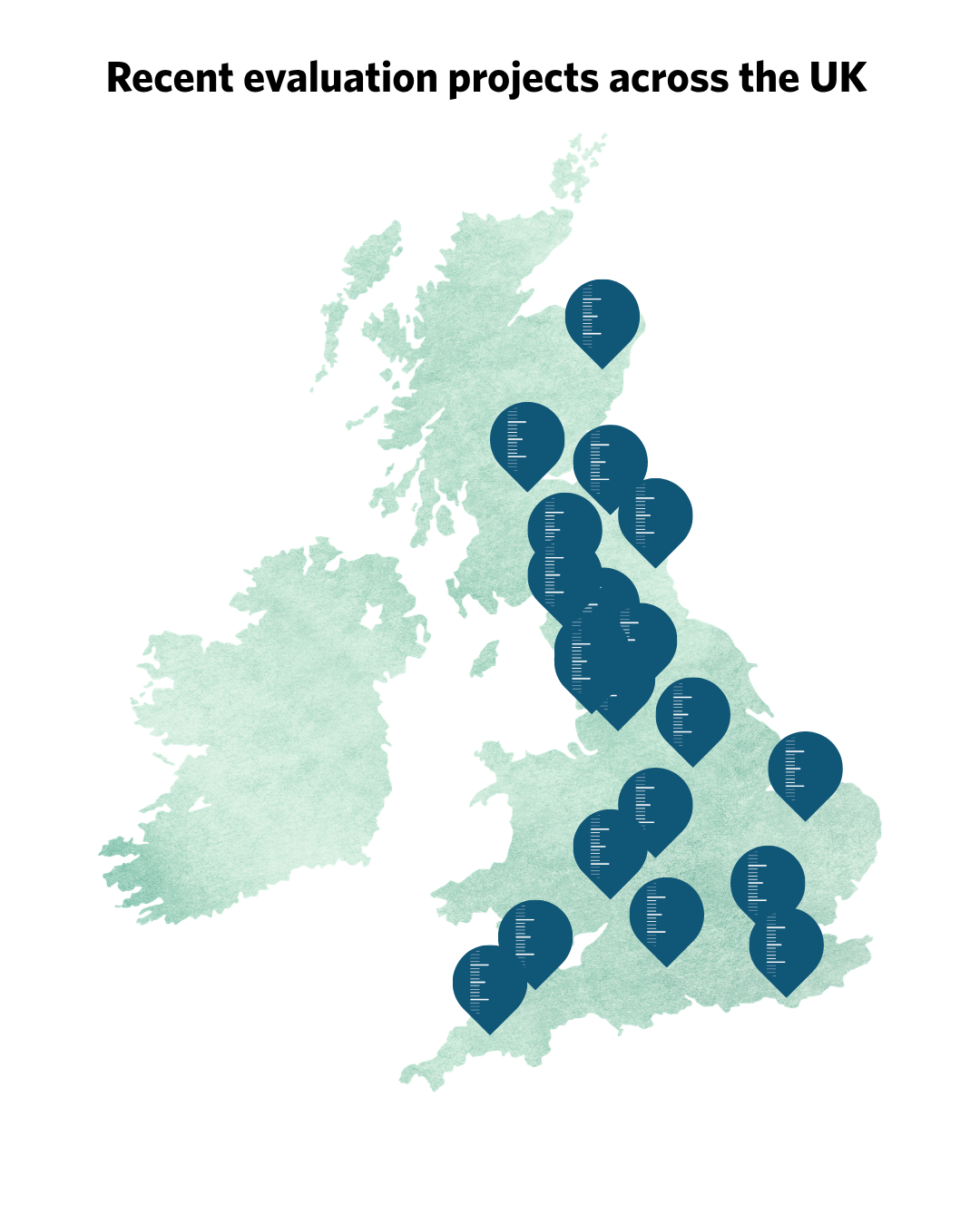
Where We Work: Evaluation Consultancy Across the UK

The Evaluator is based in Lancashire and works across the UK, supporting charities, public sector organisations and funded projects with clear, useful evaluation.

The Evaluator is based in Lancashire, but our work is not limited by where we are.

We work with charities, not-for-profits, public sector organisations and funded projects across the UK. You do not need an evaluator next door for the work to be clear, useful and well managed. What matters is good planning, strong communication and an approach that fits the project.

A snapshot of recent evaluation projects across Scotland, the North of England, London, Norfolk and the South West.

Recent work across different places

Over the last year, our evaluation work has taken us across a wide range of locations and local contexts.

This has included work in London with Hackney Foodbank, climate-focused work around the Forth Estuary through Climate FORTH, and evaluation support for Love to Move in Scotland.

In County Durham, we have worked in Shildon and Newton Aycliffe. Through Freshwater Renaissance, we have supported a multi-site nature project with activity in Devon, Somerset, Cumbria and Norfolk. We have also worked on Nature Calling, which involves projects across different UK locations.

Each place is different. That is part of the point.

Good evaluation is not about applying the same template everywhere. It is about understanding the project, the people, the setting and the evidence needed. A community project in London, a nature project in Norfolk and a climate programme in Scotland will all have different pressures, partners and audiences.

Based in Lancashire, working UK-wide

Being based in Lancashire gives us a strong northern base, but it does not limit who we can support.

Some evaluation work is best done in person. Some can be done remotely. Most projects benefit from a thoughtful mix of the two. We shape the approach around what is proportionate, practical and useful for the client.

That means we can support projects well even when we are not based nearby.

For clients, the reassurance is simple: we know how to work across distance without making evaluation feel distant.

Planning a project outside Lancashire?

If you are planning a funded project and wondering whether we can support you from where we are, the answer is probably yes.

We work with organisations across the UK and bring the same focus wherever the project is based: honest evidence, useful learning and creatively simple evaluation.

Project Evaluation

Project Evaluation Services

Turning Delivery Into Evidence-Based Insight

How The Evaluator helps projects prove and improve impact.

In an increasingly competitive funding landscape, delivery alone is no longer enough. Funders expect clear evidence of outcomes,
robust evaluation frameworks, and credible insights that demonstrate value for money and long-term impact.

At The Evaluator, we specialise in project evaluation that meets funder requirements while remaining genuinely useful for delivery teams.
Our work spans heritage, environmental, arts, culture, and community programmes, combining methodological rigour with real-world pragmatism.

Evaluation That Funders Trust and Teams Actually Use

Our evaluations are designed to do two things simultaneously:

  • Stand up to external scrutiny from funders, commissioners, and auditors.
  • Support internal learning and decision-making, rather than sitting unused on a shelf.

We are fluent in the expectations of major funding bodies, including Arts Council England,
the National Lottery Heritage Fund (NLHF), DEFRA, and Sport Scotland.

A Human, Rigorous Approach

Effective evaluation is not just about data volume; it is about insight, context, and meaning.
We use mixed-methods approaches that blend quantitative evidence with qualitative depth:

  • Interviews and focus groups
  • Surveys and statistical analysis
  • Case studies and impact storytelling

Case Study: Urban Forest Accelerator

Delivered with the Community Forest Trust, National Trust, and Woodland Trust.

The programme supported councils to embed tree equity into urban planning, strengthen climate resilience,
and improve community wellbeing. Our evaluation drew on 83,000+ data points.

  • Tree equity mapping for low-canopy, high-deprivation areas
  • Toolkit for councils and delivery partners
  • 300+ participants engaged
  • Urban Greening Code and finance models
  • 42+ organisations in a UK-wide coalition

What Sets The Evaluator Apart

Strategic value

Evidence that improves delivery and funding.

Quality assured

ISO-aligned, GDPR compliant, DBS-checked.

Cross-sector

From SROI to learning reviews.

Mission-led

Data as a practical asset.

Ready to talk?

We’ll tailor a right-sized, funder-ready evaluation that’s genuinely useful.

Evaluation Services that Drive Impact, Insight and Innovation – The Evaluator UK

At The Evaluator, we offer a comprehensive suite of evaluation services tailored to the needs of UK organisations across the cultural, community, and public sectors. From project evaluation and social return on investment to bespoke evaluation frameworks and digital tools, our work is designed to generate actionable insights and support real-world impact. Whether you’re measuring change, improving delivery, or strengthening your case to funders, we help you tell your story with clarity, confidence, and evidence. Explore our services to see how evaluation can drive your mission forward.

Our services

Project Evaluation

The Evaluator takes a strategic and insightful approach to project evaluation, ensuring that data collection is not just a process but a tool for real impact. We go beyond ticking boxes, focusing on gathering meaningful insights that help shape and strengthen organisations. By balancing efficiency with depth, we ensure that every piece of data serves a clear purpose—helping organisations to understand their audiences, measure success, and identify opportunities for growth. Our evaluations are not just about reporting results; they are about guiding future decisions, making sure that each project reaches its full potential.

At the core of our approach is a commitment to making evaluation both practical and powerful. We recognise common challenges, such as time constraints and survey fatigue, and address them with streamlined, intelligent methods that prioritise quality over quantity. Our focus is not on overwhelming organisations with data but on ensuring that insights are actionable and drive meaningful change. Crucially, we believe that data should never sit unused in reports—it should actively shape the future. Through our work, we help organisations remain relevant, responsive, and ready to grow, turning evaluation into a dynamic force for progression.

Evaluation Frameworks

At The Evaluator, we create evaluation frameworks that are clear, strategic, and designed for real-world impact. Our frameworks are not just documents—they are roadmaps that guide organisations in measuring success effectively and meaningfully. We take a tailored approach, ensuring each framework aligns with an organisation’s goals, values, and ambitions. By identifying the right metrics and methods, we help organisations track progress, demonstrate value, and make informed decisions. Our focus is always on creating frameworks that are practical, easy to use, and capable of driving real learning and improvement.

What sets our evaluation frameworks apart is our ability to balance rigour with usability. We strip away unnecessary complexity and provide structured, accessible tools that make data collection and analysis seamless. We ensure that organisations don’t just gather data but use it to reflect, adapt, and grow. Our frameworks give teams the confidence to evaluate their work effectively, turning insights into action. By embedding evaluation at the heart of a project, we empower organisations to make a lasting impact, proving not just what they have achieved but how they can achieve even more.

Social Return on Investment

At The Evaluator, we design Social Return on Investment (SROI) projects that go beyond the numbers, capturing the full impact of an organisation’s work. We take a rigorous yet accessible approach, translating complex data into clear, compelling insights that showcase both financial and social value. Our method goes beyond traditional reporting, helping organisations quantify the wider benefits they create—whether that’s improving wellbeing, increasing opportunities, or strengthening communities. By working closely with organisations, we ensure that our SROI projects reflect their unique impact, providing the evidence they need to demonstrate their value with confidence.

Our expertise lies in making SROI both meaningful and actionable. We don’t just calculate figures; we tell the story behind them, ensuring that social impact is fully recognised and understood. Our process helps organisations to identify where they are making the biggest difference and where they can maximise their impact even further. With a focus on clarity and strategic insight, we provide organisations with the tools needed to communicate their value to funders, stakeholders, and communities. Through our SROI projects, we empower organisations to strengthen their case for support, enhance decision-making, and drive lasting, positive change.

Impact Evaluation

At The Evaluator, we deliver impact evaluations that go beyond surface-level reporting to uncover the true effects of a project or programme. Our approach is rooted in clarity, relevance, and depth, ensuring that organisations can confidently demonstrate the differences they are making. We design evaluations that capture both the tangible and intangible outcomes—whether it’s shifts in attitudes, improvements in wellbeing, or long-term societal benefits. By using robust methods tailored to each organisation’s needs, we provide meaningful insights that highlight successes, identify areas for growth, and support future planning.

What sets our impact evaluations apart is our ability to turn data into compelling narratives that resonate with stakeholders. We go beyond simply measuring change; we help organisations to understand why and how change happens. Our evaluations provide actionable insights, helping teams refine their strategies and amplify their impact. With a focus on practical recommendations, we ensure that evaluation is not just a retrospective exercise but a forward-thinking tool for learning and development. Through our work, we help organisations strengthen their impact, communicate their value effectively, and drive meaningful, lasting change.

Process Evaluation

At The Evaluator, we specialise in process evaluations that provide organisations with a clear understanding of how their work is being delivered and where it can be optimised. Our approach focuses on uncovering what’s working well, identifying challenges, and refining processes to maximise effectiveness. By examining implementation, decision-making, and operational dynamics, we help organisations strengthen their approach in real-time rather than waiting until a project’s end. Our evaluations are designed to be practical and insightful, offering clear recommendations that enhance efficiency, improve delivery, and ensure resources are being used to their full potential.

What makes our process evaluations stand out is our commitment to making them both reflective and action-driven. We don’t just map out workflows—we identify opportunities for streamlining, innovation, and growth. We work closely with organisations to ensure that their processes are not only effective but also sustainable and scalable. By embedding evaluation within delivery, we enable teams to adapt quickly, build resilience, and drive continuous improvement. Our evaluations turn operational insights into strategic advantages, helping organisations refine their work, strengthen their impact, and deliver with even greater confidence.

The Returns Recipe – NPO Data Return Service


The Evaluator’s NPO Return Process is a game-changing solution for National Portfolio Organisations navigating the complexity of Arts Council reporting. Designed specifically to reduce stress, save time, and boost confidence, this tailored service transforms data return from a chore into a powerful planning tool. By blending clarity, consistency, and deep understanding of the sector, The Evaluator ensures that your data returns and submissions not only meet compliance but also tell a compelling story about your impact, reach, and growth. From audience figures to workforce data, every part of the process is handled with care, strategic insight, and a sharp eye for detail.

What sets this service apart is our personal touch and sector-savvy approach. The Evaluator doesn’t just process your data—we help you make sense of it. This hands-on support includes clear templates, one-to-one advice, and optional additional analysis that turns raw numbers into meaningful insights for funders, boards, and teams alike. Whether you’re a seasoned NPO or new to the process, this service empowers you to submit with confidence, learn from your data, and use it to shape your future. It’s not just about returns—it’s about unlocking your organisation’s potential.

72 Seasons

72 Seasons is a beautifully creative project designed to deepen our connection with nature while enhancing wellbeing. Originally conceived as a research initiative by Kirsty Rose, founder of The Evaluator, it began as an exploration of how noticing small, seasonal changes can positively impact how we feel. Inspired by the ancient Japanese natural calendar of 72 micro-seasons, the project now presents a uniquely British take on these ever-shifting cycles of nature. Every four to five days, a new “season” emerges, inviting people to slow down, observe, and appreciate the subtle transformations happening all around them. Through social media, storytelling, and creative prompts, 72 Seasons encourages participants to engage with the world in a mindful, immersive way—whether that’s through photography, drawing, journaling, or simply taking a moment to notice.

At its heart, 72 Seasons is a co-created experience, shaped by the insights and observations of a dedicated community of seasonal seekers. This collaborative spirit has been integral from the start, with volunteers helping to define and refine the seasons through shared experiences and reflections. The project has evolved to be both a personal and collective journey, sparking curiosity and creativity in those who take part. People engage with it in different ways—some following along online, others using it as a guide for personal exploration or research into climate patterns. It’s a celebration of creativity, connection, and nature’s rhythms, offering a fresh perspective on the changing world around us. More than just a calendar, 72 Seasons is a movement—one that invites people to pause, notice, and find joy in the beauty of everyday nature.

Volunteer App

In 2024 we have been working on a co-created volunteer app, developed in collaboration with a volunteer in a professional capacity. Inspired by the Wilder Walkmill project and the historical Miners’ Tally Check System, this app modernises an age-old safety and tracking method. Just as colliers once checked in and out with pit checks, volunteers now create a virtual ‘tag’, recording their time and experiences on-site. This ensures project staff can keep track of volunteers for safety, support, and engagement, while also capturing rich qualitative data about their experiences. More than just a digital tool, this app is a testament to co-creation, heritage, and innovation, demonstrating how past practices can inspire future solutions. By integrating real-time feedback, this app enhances volunteer experience, strengthens project evaluation, and provides funders with invaluable insights, making it a game-changer for future community-led projects.

Miners’ tally checks were an essential safety system used in coal mines to track which workers were underground at any given time. Each miner had two identical checks—often made of brass, zinc, or aluminium—one handed in at the start of a shift in exchange for a lamp, and the other kept with them. This system ensured that in the event of an accident, supervisors could quickly identify who was still inside the mine. The checks came in various shapes and designs, sometimes featuring the miner’s number or the colliery’s name, making them a practical yet deeply personal part of mining history.

Data Dashboards and Organisational Evaluation – (coming soon)