What Happens After You Appoint an External Evaluator?

What happens after you appoint The Evaluator?

Appointing an external evaluator can feel like handing an important part of your project to people you do not yet know very well. You may be wondering how much time the process will take, what your team will be expected to do, whether the evaluator will understand the work quickly enough, and whether problems will be spotted before the final report.

Those are reasonable concerns. A strong proposal matters, but clients also need confidence in what happens after the contract is signed.

Our job is to make evaluation feel held: clear responsibilities, sensible tools, regular contact and enough challenge behind the scenes to produce findings that stand up to scrutiny. This is the process you can expect from us.

1. We begin by getting the important things out of people’s heads

The first stage is inception. We review the brief, funding requirements, project plans, existing monitoring and any previous research. Then we talk through what the project is really trying to achieve, what is already happening and where the uncertainties sit.

This is often where different strands begin to join up. Projects can involve several partners, audiences, activities, outcomes and reporting requirements. We create a shared picture, agree priorities and make decisions about what the evaluation can realistically answer.

This is often the point when people start to feel excited about the evaluation: the project becomes clearer, the possibilities begin to emerge, and the team can see how the process will support their work. We also begin agreeing the practical arrangements and responsibilities, building these out as the evaluation develops.

2. We turn ambition into answerable questions

Funding applications often contain broad and overlapping ambitions. Our role is to translate those into a focused set of evaluation questions and, where useful, a theory of change.

That means identifying the route from activity to outcomes, the assumptions underneath it and the evidence that will help us judge progress. We also review your targets and deliverables, checking that everyone understands what needs to be counted, how it will be recorded and who will be responsible. Where possible, we establish baselines or sensible comparison points and make clear where evidence will be indicative rather than conclusive.

This work creates the spine of the evaluation. Without it, projects can collect a great deal of information and still struggle to demonstrate what they delivered or answer the questions that matter.

3. We build tools that work in the real world

Next, we develop the evaluation framework and practical toolkit. This could include monitoring templates, surveys, interview guides, observation tools, participant reflection, demographic questions or creative in-person methods.

The right tool depends on the setting. A short community activity, an outdoor festival, a long-term volunteer programme and a strategic partnership cannot all be evaluated in the same way.

We design first for the people who will actually use and respond to the tools, as well as for the evidence the evaluation needs. If you are working with people experiencing deprivation, people facing language barriers, children or people with complex disabilities, we will adapt both the method and the way it is delivered so that participation is practical, appropriate and meaningful.

That might mean using simpler language, visual or creative approaches, supported conversations, shorter questions or accessible alternatives to a conventional survey. We aim to create methods that work in real settings—not polished, bureaucratic tools that look impressive on paper but place unnecessary demands on participants or delivery teams.

4. We make responsibilities manageable

External evaluation works best as a clear partnership. Your team may hold attendance records, capture routine feedback or introduce us to participants. We may lead deeper interviews, focus groups, observation, analysis and independent reporting.

We agree that division early and provide support where needed. This might include a short training session, written guidance, worked examples or a regular check-in. The aim is not to turn delivery staff into researchers. It is to make the information they gather consistent and useful without adding unnecessary weight to their jobs.

5. We check the evidence while the project is live

One of the biggest risks in evaluation is waiting until the end to discover that an important question was not asked or that data has been recorded inconsistently.

We build in proportionate progress and data-quality checks. We look at what is coming in, whether different groups are being heard, where response rates are weak and whether delivery changes affect the original framework. If something is not working, we raise it while there is still time to adapt.

These conversations are not about catching clients out. They are about protecting the final evaluation and helping the project learn during delivery.

6. We analyse, compare and challenge

Analysis is more than summarising a spreadsheet or selecting good quotations. We look for patterns, differences between groups, changes over time and explanations for what we are seeing. We compare monitoring data, surveys, interviews, observation and other sources rather than treating each in isolation.

We also look for evidence that complicates the emerging story. Where samples are limited, baselines are missing or other factors may have contributed to change, we say so. Conclusions are tested within the wider team before they become part of the report.

That internal challenge is a core part of our quality assurance. Accessible writing is the final layer; underneath it sits careful analysis and professional judgement.

7. We turn findings into something people can use

The report should give funders and boards confidence, but it should also help the people delivering the work. We structure findings around the questions and outcomes that matter, show how conclusions were reached, and make limitations clear without allowing them to obscure useful learning.

Recommendations are grounded in the evidence and proportionate to the organisation’s capacity. Depending on the commission, we may also present findings, run a learning session or produce concise visual material for wider audiences.

Our aim is not to leave a large document behind and disappear. It is to help the right people understand what the evidence means and what to do next.

What happens when projects change?

Projects change because funding is delayed, staff move, activities evolve, partners join or audiences respond differently from expected. Evaluation has to be structured without becoming rigid.

We keep the central questions in view, record agreed changes and adapt tools or timing where that protects the usefulness of the work. If a change affects scope or budget, we explain that early rather than allowing a surprise to appear at the end.

What about capacity and continuity?

Clients appoint The Evaluator as a consultancy, not an isolated individual. Each project has clear leadership and project management, with wider team involvement in delivery, analysis, review and cover. Our systems hold actions, deadlines and decisions so that continuity does not rely on one person remembering everything.

That team structure matters. It gives clients consistent contact while bringing more than one perspective to important findings. It also means quality and progress can be protected through busy periods, leave and the ordinary realities of working life.

What we need from you

Good evaluation does require collaboration. We will need timely access to relevant documents and data, honest conversations about delivery, help reaching participants or stakeholders, and enough notice of key events and changes.

In return, we take responsibility for holding the evaluation: keeping the framework coherent, making sense of evidence, identifying risks, asking the difficult questions and turning complexity into clear, useful findings.

If you are planning an evaluation and want to understand what the process would look like for your project, send us your brief—or talk to us before the brief is finished. We will help you work out a proportionate route from the questions you have now to evidence you can confidently use.

How to Choose an Evaluation Consultant in the UK

How to choose the right evaluation consultant for your project


Evaluation proposals often share several positive features, including mixed methods, stakeholder engagement, opportunities for learning and a final report. If you are comparing quotes, the difficult question is not whether the right words appear. It is whether the proposed work will produce evidence you can trust—and whether the process will be manageable for your team.

The best evaluator for your project is not necessarily the biggest provider, the cheapest bidder or the proposal containing the highest number of interviews, workshops and site visits. More data collection can sound reassuring, but it may also create a significant workload for your team—particularly if you are expected to recruit participants, coordinate visits or gather the data yourselves. The right evaluator will understand what you need to learn, propose a credible and manageable approach, and have the systems and experience to turn the evidence into useful conclusions.

Here are the things we would look for—even if you are considering somebody else.

1. They understand the purpose, not just the specification

A good proposal shows that the evaluator has understood the project, its context and the decisions the findings need to support. It does more than repeat your brief back to you.

Look for a clear line between your aims, the evaluation questions, the proposed evidence and the outputs. If the method could be copied unchanged into almost any tender, it may not yet be tailored enough.

2. The scope is deliverable — not simply impressive

A long list of interviews, workshops, surveys and site visits can look reassuring. However, every activity requires recruitment, preparation, delivery, recording, analysis and interpretation. When comparing proposals, consider whether the available days and fee genuinely cover the work being promised.

You could also ask bidders to show how their time is divided between project management, data collection, analysis and reporting. This can reveal whether an apparently generous methodology leaves enough time to make sense of the evidence.

An experienced evaluator will make deliberate choices. They may focus interviews on the stakeholders with the clearest view of change, use existing evidence more intelligently or sample activity instead of attending everything. This is not a reduction in quality. It is what makes the work deliverable and protects the quality of the analysis.

3. The methods answer different questions

‘Mixed methods’ is valuable only when the mix has a purpose. Monitoring data might show reach. Surveys might show patterns. Interviews might explain how or why change happened. Observation might reveal something participants do not easily put into words.

The proposal should explain what each source contributes and how they will be considered together. Collecting several types of evidence without a plan for comparison can create more data without creating more confidence.

4. They distinguish contribution from attribution

Real-world projects rarely operate in isolation. People, places and organisations are influenced by many factors. An evaluator should be able to explore how your work contributed to change without automatically claiming it caused everything that followed.

That honesty does not weaken a report. It makes the findings more believable to funders, boards and partners.

5. They make limitations visible

Every evaluation has limitations: incomplete baselines, small samples, uneven monitoring, selection bias or changes to delivery. The question is whether those limits are understood and handled.

Ask how the evaluator will assess data quality, record gaps and test alternative explanations. Be cautious of anyone who appears to guarantee strong impact findings before seeing the evidence.

6. They understand delivery teams

An evaluation framework can be technically excellent and still fail because nobody has time to use it. A good evaluator will ask about capacity, existing systems and the moments when feedback can naturally be collected.

They should be able to simplify tools, provide training, check progress and adapt when delivery changes—without losing sight of the core questions. Evaluation has to survive contact with real life.

7. They can communicate clearly

Evaluation is not finished when the analysis is correct. Findings need to be understood and used. They should also create opportunities to discuss emerging findings while the project is still running. This allows teams to respond to evidence, strengthen delivery and address gaps before the final report. A good evaluation creates useful learning throughout the process—not only at the end.

Look at sample reports if they are available. Can you follow the argument? Can conclusions be traced to evidence? Are charts and case examples doing useful work? Are recommendations specific and proportionate? A polished report is valuable, but clarity matters more than decoration.

8. Quality assurance is more than proofreading

Ask who will challenge the analysis before it reaches you. Strong quality assurance includes checking calculations, testing interpretations, comparing sources, looking for contradictory evidence and making sure conclusions do not run ahead of the data.

It is also worth understanding who will actually undertake the work. Who will design the tools, conduct the fieldwork, analyse the evidence and write the report? How involved will the named senior evaluator remain?

A senior name on the front of a proposal offers limited reassurance if most of the work is delegated without clear oversight. Equally, relying entirely on one consultant can create risks around continuity and internal challenge. Look for a clear delivery team, defined responsibilities and meaningful senior involvement throughout.

9. You know how the relationship will work

A good quote should make the practicalities visible: named contacts, responsibilities, meeting rhythm, milestones, outputs, assumptions and what the client needs to provide. It should explain how changes will be handled and how continuity will be maintained if somebody is unavailable.

You are not only buying a methodology. You are choosing people who will work alongside your team, speak to participants and represent the evaluation with partners. Calm, clarity and responsiveness matter.

Questions worth asking before you appoint

  • Can you show how the proposed days realistically cover recruitment, fieldwork, analysis, project management and reporting?
  • What is/are the most important evaluation question(s) here?
  • What choices have you made to keep the evaluation proportionate and deliverable?
  • How much data collection will our team need to do?
  • How will you know whether the evidence is strong enough?
  • How will you compare different sources and deal with contradictions?
  • Who will conduct the fieldwork, analysis and writing?
  • What happens if delivery or timescales change?
  • How will findings be shared so that people actually use them?

The answers will often tell you more than an extra page of methodology.

What choosing well feels like

The right evaluator will not make every uncertainty disappear at procurement stage. Good evaluation involves learning. But they will make the route feel clearer. You should understand what they are trying to find out, why the approach is proportionate, what your team will need to do and how quality will be protected.

At The Evaluator, our role is to hold the complexity without passing it back to the client. We design rigorous evaluation underneath while keeping the experience straightforward for delivery teams and participants.

Our proposals set out what we will do, who will do it and how the available time will be used. We do not inflate the methodology to make a tender appear more impressive. We propose the work we believe can be delivered properly, with sufficient time for thoughtful analysis, internal challenge and clear reporting.

Our team works together across project management, data quality, fieldwork, analysis and quality assurance. Clients receive a managed consultancy service, with senior oversight and continuity built in, rather than depending on one person holding everything in their head.

If you are preparing an evaluation brief or comparing possible approaches, send us your project outline. We will give you an honest view of what the evaluation needs, what is achievable within the available budget and where we could add the most value.

Choosing an evaluation consultant? Learn what charities, not-for-profits and public sector teams could look for when appointing an external evaluator.

How to Choose the Right Evaluation Consultant for Your Project

If you are a charity, not-for-profit or public sector organisation looking for an evaluation consultant in the UK, it can be hard to know who to appoint.

From the outside, evaluators can look quite similar. Most will talk about impact, evidence, methods and reporting. Most can write a proposal that sounds credible. But the real question is not simply who writes the most polished tender.

The real question is: who will help you understand your project clearly, collect the right evidence, and turn that evidence into something you can actually use?

That matters because evaluation is often commissioned at an important moment. You might be preparing for a major grant, working through a development stage, or starting delivery after a significant funding award. There is usually a lot at stake. You need confidence that the evaluation will satisfy funders, support learning and help your team make better decisions.

So how do you choose the right evaluation consultant?

Start by asking people you trust

One of the best ways to find a good evaluator is still the simplest: ask around.

Ask your peers. Ask partner organisations. Ask funders, advisers, trustees or other senior leaders who have commissioned evaluation before. If someone has had a good experience with an evaluator, they will usually be able to tell you what made the process work.

This is useful because evaluation is not just a technical service. It is a working relationship.

You need someone who can understand the project, work well with senior leaders and delivery teams, ask good questions, make sense of complexity and communicate findings clearly. A recommendation from someone who has already worked with an evaluator can tell you a lot more than a website or proposal alone.

Look for relevant experience and previous work

Track record matters.

If your project involves community engagement, arts and culture, heritage, nature, health, wellbeing or place-based work, it helps to appoint someone who understands those settings. They do not need to have evaluated an identical project, but they should understand the reality of delivery.

Good evaluators know that participation can be uneven, delivery teams are busy, and community work does not always fit neatly into a spreadsheet. They know how to gather evidence without creating unnecessary work.

Ask to see examples of previous reports or outputs. A useful evaluation report should not just look impressive. It should be readable, honest and practical. You should be able to imagine giving it to trustees, funders, partners or senior colleagues and seeing how it would support decisions.

Ask how they would approach the project

Before asking for a full quote, it is worth having an informal conversation.

Look for evaluators who are willing to offer a 20 to 30 minute chat before they write a proposal. This gives you a much better feel for how they think. What questions do they ask? Do they understand the project quickly? Do they spot the right challenges? Do they make the process feel clearer or more complicated?

It also helps you work out whether you would enjoy working with them.

At The Evaluator, we usually try to have this kind of conversation before writing a quote. It helps us understand the client as well as the project. A tender brief can tell us what the work is, but a conversation often tells us how the organisation thinks, what they are worried about, and where evaluation could be most useful.

That matters because a good evaluator should not just price a list of pre-decided outputs. They should help you work out what level of evaluation is proportionate.

Sometimes organisations ask for more than they need. Three reports might sound thorough, but they may not be the best use of the budget. In some projects, one strong evaluation framework, a small number of well-designed tools and good support with data collection will be far more useful.

Do not judge only by the polish of the tender

A clear proposal matters. But the best evaluation partner is not always the organisation with the glossiest tender.

A larger consultancy may have a dedicated tender writer or more capacity to produce a very polished document. A smaller specialist team may not be able to spend a full week making a proposal look beautiful, because the senior people writing the quote are also the people designing, managing and delivering the work.

That difference matters.

A polished tender does not always tell you who will actually do the evaluation, how involved senior people will be, or whether the evaluator will stay close to the reality of the project once delivery begins.

So look beyond the procurement document. Ask who will lead the work, who will analyse the evidence and who will write the report.

Good evaluation depends on judgement, not just process.

Choose someone who makes evaluation useful

Good evaluation is not about collecting as much data as possible. It is about collecting the right amount of data, in the right way, and using it well.

That is where the best evaluation consultants add value. They help you avoid wasted effort. They design tools that work in real settings. They reduce duplicated requests. They make the process manageable for staff, volunteers, partners and participants.

At The Evaluator, we describe this as being creatively simple.

The process should feel simple for the people taking part. A survey should be easy to complete. A feedback activity should feel welcoming. A workshop should generate useful insight without feeling over-engineered.

Behind the scenes, the analysis may be complex. But that complexity should not be passed on to the client. The evaluator’s job is to do the hard thinking, make sense of the evidence, and present it back clearly.

A good evaluation consultant should bring relevant sector experience, proportionate methods, clear communication, honest analysis and practical recommendations that help funders, boards and delivery teams understand what the evidence means.

Look for honesty, not just positive findings

Evaluation is not marketing.

A good evaluator should recognise success, but they should also tell you what the evidence does and does not show. That kind of honesty is what makes evaluation credible.

A useful report explains what worked, for whom and why. It notices where outcomes were weaker or where delivery changed. It recognises the limits of the evidence. It helps you understand what is worth continuing, what needs adapting and what questions remain.

That should not feel threatening. Done well, honest evaluation gives organisations more confidence, not less.

Three questions to ask before appointing an evaluator

If you are choosing an external evaluator, these three questions will tell you a lot.

  1. Can you show us relevant previous work or connect us with a past client? This helps you understand both the quality of their outputs and what they are like to work with.
  1. How would you approach this project? This shows whether they can think strategically, not just respond to a brief.
  1. Who will actually deliver the evaluation? This helps you understand whether the people writing the proposal will be close to the work itself.

What a good evaluator should leave behind

A good evaluation should leave you with more than a report.

It should leave you with knowledge and a clearer sense of where you are going.

When organisations do not have good evidence, they can end up worrying about everything. Every issue feels equally urgent. Every decision feels uncertain. But when you look carefully at the numbers, the stories, the feedback and the wider context, priorities often become much clearer.

Good evidence helps you make decisions with more confidence.

It can show you what to scale, what to adapt, what to stop, what to explain to funders and what to focus on next.

So when you are choosing an evaluation consultant, do not only ask who has written the most polished tender.

  • Ask who will understand your project.
  • Ask who will make the work proportionate.
  • Ask who will be honest with you.
  • And ask who will turn complex evidence into clear learning you can actually use.

Planning to appoint an evaluator?

If you are preparing a brief, developing a funding bid or starting a newly funded project, we are happy to have an initial conversation about what level of evaluation would be proportionate, useful and manageable for your team.

Where We Work: Evaluation Consultancy Across the UK

The Evaluator is based in Lancashire and works across the UK, supporting charities, public sector organisations and funded projects with clear, useful evaluation.

The Evaluator is based in Lancashire, but our work is not limited by where we are.

We work with charities, not-for-profits, public sector organisations and funded projects across the UK. You do not need an evaluator next door for the work to be clear, useful and well managed. What matters is good planning, strong communication and an approach that fits the project.

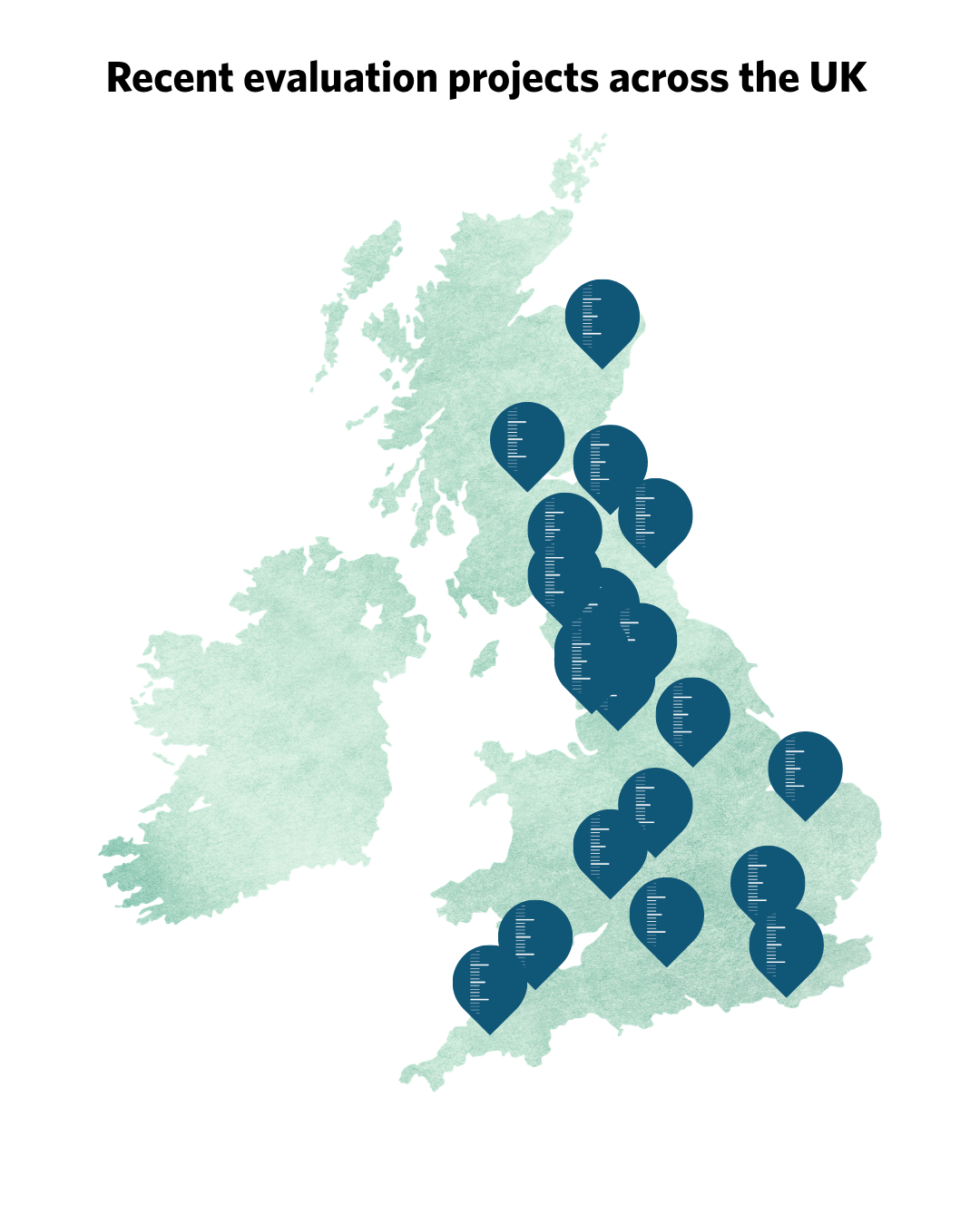
A snapshot of recent evaluation projects across Scotland, the North of England, London, Norfolk and the South West.

Recent work across different places

Over the last year, our evaluation work has taken us across a wide range of locations and local contexts.

This has included work in London with Hackney Foodbank, climate-focused work around the Forth Estuary through Climate FORTH, and evaluation support for Love to Move in Scotland.

In County Durham, we have worked in Shildon and Newton Aycliffe. Through Freshwater Renaissance, we have supported a multi-site nature project with activity in Devon, Somerset, Cumbria and Norfolk. We have also worked on Nature Calling, which involves projects across different UK locations.

Each place is different. That is part of the point.

Good evaluation is not about applying the same template everywhere. It is about understanding the project, the people, the setting and the evidence needed. A community project in London, a nature project in Norfolk and a climate programme in Scotland will all have different pressures, partners and audiences.

Based in Lancashire, working UK-wide

Being based in Lancashire gives us a strong northern base, but it does not limit who we can support.

Some evaluation work is best done in person. Some can be done remotely. Most projects benefit from a thoughtful mix of the two. We shape the approach around what is proportionate, practical and useful for the client.

That means we can support projects well even when we are not based nearby.

For clients, the reassurance is simple: we know how to work across distance without making evaluation feel distant.

Planning a project outside Lancashire?

If you are planning a funded project and wondering whether we can support you from where we are, the answer is probably yes.

We work with organisations across the UK and bring the same focus wherever the project is based: honest evidence, useful learning and creatively simple evaluation.

What funders really need from evaluation — and what delivery teams need too

Useful evidence for real teams

People sometimes talk as if funders and delivery teams want completely different things from evaluation.

Funders, supposedly, want hard evidence, clean reporting and polished success stories. Delivery teams, meanwhile, want something practical, lightweight and not too disruptive.

There is some truth in that. But in reality, the gap is often smaller than people think.

What funders really need is confidence that a project is being run thoughtfully, that the evidence is credible, and that the team is honest about what is working and what is not. What delivery teams really need is something manageable, clear and useful enough to help them do the work well.

Good evaluation should do both.

Funders do not just want positive stories. They want credibility.

One of the biggest misconceptions about evaluation is that funders mainly want proof that everything is going brilliantly.

In our experience, that is not quite right.

What builds trust is not pretending a project is perfect. It is being clear about what has gone well, what has been harder, what has been learned, and what needs to improve next. That kind of honesty builds credibility. It shows that the team is paying attention, taking the work seriously and not simply producing a glossy version of events.

That matters.

Once funders trust that a team is genuinely looking at what needs fixing as well as what is succeeding, the relationship tends to become much stronger. The evidence feels more believable. The reporting feels more useful. The organisation looks more capable, not less.

In that sense, good evaluation is not just about accountability. It is about trust.

Delivery teams need something they can actually live with

On the delivery side, the biggest need is often much simpler.

Most charities, arts organisations, heritage projects and community programmes are trying to do a great deal with limited time and limited capacity. It is very rare to find a team sitting around with spare hours and no pressure on delivery.

That means the secret to a good evaluation system is often not complexity. It is simplicity.

It needs to be easy enough to do properly. Clear enough to understand. Light enough to fit around real work. If it becomes too heavy, it does not matter how clever it looks on paper. It will either be done badly, done inconsistently, or quietly abandoned when things get busy.

That is not a failure of the team. It is usually a failure of the evaluation design.

Where people get it wrong

The most common mistake is trying to do everything.

Teams collect too much, ask too much, track too much and promise too much. They end up with forms, spreadsheets, feedback tools and reports in every direction, but not enough time to step back and ask what any of it means.

That is how organisations end up gathering lots of data and using very little of it.

And that has a cost.

If you do not build in time to analyse and interpret what you are collecting, the effort is largely wasted. Worse than that, people who have taken the time to give feedback can end up feeling let down, because nothing visible comes from it. Over time, that contributes to survey fatigue, which is already a real problem.

So poor evaluation does not just create internal clutter. It can slowly damage trust with participants too.

Good evaluation slims the picture down

This is where good evaluation does something much more useful.

It asks: what do we actually need to know?

Not everything. Not every possible metric. Not every interesting question. The right things.

Then it helps teams measure those things properly, measure them regularly enough to be useful, and make space to analyse and act on what comes back.

That is the part people often miss. Collection is only one stage. The real value comes from interpretation and use.

A good evaluation process keeps a team on track. It helps them focus on the evidence that matters most. It turns data into something practical, not just something stored.

Good evaluation should help both sides at once

At its best, evaluation does not force a choice between funder needs and delivery needs.

It gives funders a clearer, more trustworthy picture of what is happening.

And it gives delivery teams something just as valuable: a way of seeing their own work more clearly.

That might mean showing where outcomes are strongest. It might mean identifying where more attention is needed. It might mean noticing that one part of the work is doing far more than another, or that a process feels heavier than the value it is generating.

This is where evaluation becomes genuinely useful. Not just because it helps produce a final report, but because it helps people steer.

Usability matters as much as rigour

Another important part of this is how findings are shared back.

Even good evidence can lose its value if it is presented badly.

We spend a lot of time thinking about how to make findings understandable, usable and easy to act on. That means clear writing, simple presentation of information, and working with clients in ways that help the ideas land properly. Sometimes that means presentations. Sometimes it means workshops. Sometimes it means creating tools or visuals that make the evidence feel tangible rather than abstract.

Because if people cannot grasp the learning, they cannot use it.

And if they cannot use it, the evaluation has not really done its job.

What funders and delivery teams both need

In the end, the best evaluation is not about pleasing one side and burdening the other.

It is about creating something credible enough to build trust and simple enough to be sustained.

Funders need honesty, seriousness and evidence they can believe.

Delivery teams need clarity, manageability and feedback they can actually use.

Good evaluation gives both by being proportionate, focused and genuinely useful. It does not try to measure everything. It does not create noise for the sake of looking thorough. It identifies what matters, measures it well, and helps people act on what they learn.

  • That is what makes it valuable.
  • Not just more reporting.
  • Better judgement, stronger trust and a clearer sense of what to do next.

Need evaluation that satisfies funders without burying your team in admin? We help organisations build evidence that is credible, proportionate and actually usable.

How to measure pride in place, belonging and community change

How to measure local belonging

People often talk about pride in place, belonging and community change as if they are too vague, too emotional or too intangible to measure properly.

We do not think that is true.

These outcomes can be measured, and they matter. But they need to be handled carefully. You cannot reduce them to one headline number and call it done. Equally, you do not need to throw up your hands and say they are impossible to evidence. Good evaluation sits in the middle. It translates broad ideas into clear questions, gathers evidence in ways people can answer honestly and easily, and combines numbers with richer insight so the findings actually mean something.

That matters particularly in culture, heritage and place-based work, where some of the most important outcomes are about how people feel, how they connect, and whether a place starts to feel more meaningful, welcoming or full of possibility.

These outcomes are measurable

One of the most common misconceptions we come across is that you cannot really measure something like pride in place.

You can.

A large part of our job is helping clients turn broad ambitions into sensible evaluation questions. That means taking an outcome like pride in place or belonging and translating it into something people can respond to quickly and clearly. Done well, that gives you a usable numerical measure rather than a vague impression.

But we do not stop there.

Because while a good numerical measure is useful, it is rarely enough on its own. Pride in place is not just a score. Belonging is not just a percentage. Community change is not just one chart. These are lived, felt and relational outcomes. If you want to understand them properly, you also need the richer insight that comes from people’s own words, reflections and experiences.

That is why we often combine quantitative and qualitative evidence. We want to know how people answer, but also why.

Good questions matter

The real skill is not simply asking whether people feel proud of where they live. It is designing questions that are fast, clear and meaningful enough to capture something real.

That can mean creating a simple question that gives you a numerical measure you can track over time. It can also mean asking people to reflect on what has changed, what shaped their feelings, or whether they experienced the place differently before and after taking part.

The point is not to make the method feel heavy. The point is to make the evidence useful.

That is especially important in public-facing or community settings, where people may be engaging casually, briefly or in very different ways. If the evaluation feels clunky or intrusive, you will not get the best evidence anyway.

Numbers matter, but they are stronger with context

A numerical score can be helpful. It can show where you are starting from, whether things are shifting, and how different groups compare.

But a number on its own only tells you so much.

We often strengthen that evidence by combining it with qualitative insight from the people taking part in the work or experiencing a place as it changes. That might include people describing how welcome they feel, whether they speak differently about the area, whether they feel more connected to its identity, or whether they feel they have more stake in what happens there.

We also look for comparison where it helps. That might mean comparing results over time, comparing one group to another, or using wider benchmarks where appropriate. A single score is useful. A score with context is far more powerful.

Timing matters too

Another important part of this kind of evaluation is knowing when to collect the data.

Not all change happens at the same speed. Some shifts can happen quite quickly. Others take much longer to build. Part of the evaluator’s job is to understand how long this kind of change is likely to take, when it makes sense to collect a baseline, and whether a simple before-and-after approach is enough or whether a longer view is needed.

Over time, we have developed practical ways to track change without making the process cumbersome for participants. That means we can often look at change over time in a way that still feels manageable and proportionate.

Once that data is in place, we can also segment it carefully. That helps clients understand not just whether something changed, but for whom, in what context, and after which activities. That is often where the most useful insight sits.

Place-based change does not look the same everywhere

One of the most useful things evaluation can do is show that different places start from different points.

In one recent piece of work, we measured pride in place across two neighbouring towns with very different identities. One had a long-established heritage and a stronger historic character. The other was a newer town with a more industrial feel.

What we found was that pride in place was higher in the more established heritage town than in the newer one. But that did not mean the newer town was doing badly. It showed something more interesting than that: places do not all begin from the same baseline.

A lower score is not always bad news. Sometimes it shows where there is more room to grow.

That kind of finding is useful because it helps clients interpret the data more sensibly. Instead of seeing one place as “good” and another as “bad”, they can see where the opportunities are, where more effort may be needed, and how local identity may shape the pace and type of change.

Different groups may feel differently too

In that same piece of work, we also found that people aged under 19 showed higher pride in place than those aged 19 and over.

That mattered because the project was looking at change over a ten-year period. It suggested that the next generation already feels strongly connected to both places, and that this could influence how pride, belonging and local participation develop over time.

This is another reason why segmentation matters. A single overall score can hide as much as it reveals. Once you start looking by age, group, place or level of involvement, you often get a much more useful picture.

That is where evaluation moves beyond description and starts helping people think strategically.

Community change needs more than a headline number

The same is true of community change more broadly.

If you only look for one visible sign, like attendance or footfall, you will miss a lot of what matters. Community change often shows up in patterns such as stronger local relationships, more confidence to take part, greater visibility of local stories, more shared activity, better connection between groups, or a growing sense that people belong and have a stake in what happens next.

Some of that can be measured numerically. Some of it needs to be heard in people’s words. Usually, the strongest evidence comes from combining both.

  • At its best, evaluation does not flatten outcomes like pride in place or belonging into something simplistic. It makes them visible without stripping away their complexity.
  • Pride in place, belonging and community change are not too vague to measure.
  • They are just the kinds of outcomes that need thoughtful evaluation.

Working on a place-based, cultural or community project and trying to evidence change well? We help clients measure the things that matter without flattening them into something less useful.